
Online CNC Machining: How Tolerances and Surface Finishes Work Without a Full Drawing
Online CNC machining services have made precision parts easy to order: upload a model, get a price, receive parts. What the convenience hides is that the model is now the only specification, and that a part machined to an unstated tolerance is a part machined to someone else's default.
What changes when the 3D model becomes the whole specification?
A paper drawing communicates loudly: the title block states the general tolerance, the callouts name the critical features, and the notes explain the finishing requirements. A 3D model, by contrast, is silent about everything it does not dimension. When the model is the specification, the machinist's first question — "what does the designer actually care about?" — is answered by the annotations the designer chose to include, and by whatever defaults the quoting system applies where no annotation exists.
The change matters because defaults are generous by design, to keep quoting fast and prices attractive. A model without annotations will be quoted and machined to a platform default that is usually appropriate for clearance features but nowhere near tight enough for a locating bore or a precision pocket. The buyer who understands this reads the model as a specification that must be completed deliberately: annotate the features that matter, state the finish where it functions, and accept the defaults only where the function genuinely does not care.
Which features deserve tight callouts when no one will ask you?
In a conversational RFQ the supplier's engineer might ask which features are critical; online, the question never comes, so the buyer has to pre-empt it. The features that deserve deliberate tight callouts are the ones that interact: the bore that receives a pin or a shaft, the pocket width that seats a mating part, the hole pattern that aligns an assembly, the slot that a component slides into. On each of these, add the dimension or the tolerance note that the function needs, because the alternative is a default that will be held if it can and ignored if it is expensive.
A practical discipline keeps the annotations honest: put a tight band on the two or three features where the assembly depends on the number, and leave the rest to the default. This is not laziness; it is the same logic a good draftsman applies on paper, and it has the same cost benefit. Every additional tight feature on an online order is an additional operation or measurement the quoting engine must assume, and the price reflects it. The buyer who marks the functional few pays precision only where the part needs it.
Annotation grammar matters as much as annotation choices, because the machinist and the quoting engine both read the model. Express critical dimensions with tolerances the machinist can interpret without a phone call, and express location and profile against a datum scheme that exists in the part rather than in your head. A feature positioned from an edge that the process will cut away, or from a surface that is not flat enough to datum from, forces the machinist to improvise, and improvising on a tight feature is where the defaults creep back in.
How do you set surface finish expectations without a finish symbol?
Surface finish on an online-machined part is usually set through the platform's finish options or through a note attached to the model, and the buyer should treat those options as real specifications rather than aesthetic choices. A general machined finish suits structural parts that no one touches; a finer finish matters on mating faces, sealing surfaces, and parts that will be anodized or plated, because the coating reads the underlying texture. State the finish where it functions, and state the parameter if the platform allows it — Ra with a value is the language the inspector can verify.
Remember that finish is set against the material as much as the platform. Aluminum reaches fine finishes readily and anodizes well; stainless needs sharp tooling and controlled cutting to avoid a smeared texture; soft polymers can tear at the surface if the tooling is not fresh. When the material and the finish interact, the note should say what the surface is for — "sealing face, fine finish required" — so the process planner treats it as functional rather than cosmetic. The note costs nothing and prevents the most common online-order disappointment: a part that is dimensionally right and cosmetically rough where it needed to be functional.
Think ahead to any post-machining treatment when you set the finish, because the two are linked. An anodized aluminum part reads the machined texture beneath the coating, so a bright cosmetic part needs a finer pre-anodize finish than the anodize will ever provide by itself. A plated surface covers its substrate, but a rough substrate makes the plating uneven and prone to flaking under load. When the order includes a coating, set the finish with the coating in mind and say so in the note — the machinist and the coater are different steps, and the finish is the interface where they must agree.
What tolerance bands apply to common features in an online order?
The bands themselves are the same as in any precision shop, because the machines are the same. On controlled features, milling and turning hold ±0.003 mm, and the characteristics the order flags as key are held with process capability Ppk ≥ 1.67 initial. Features that need more — the bearing seat that demands ±0.002 mm — cross to precision grinding, and the online order should say so explicitly, because a grinding operation is not something a quoting engine will add on its own initiative. The bands are dependable; the question is whether the order communicated which features sit on which band.
Feature type shapes what is achievable. A through-hole that a standard drill makes is a different proposition from a reamed or bored precision hole, and the annotation should name the process expectation where it matters. A pocket's wall location is set by the toolpath and is controllable; its corner radius is set by the tool that reaches it and cannot be smaller than the tool allows. The buyer who understands which numbers the process controls directly, and which numbers are consequences of tooling, writes annotations the machinist can actually meet.
How do you avoid the assumptions that automated quoting makes?
Automated quoting engines make assumptions because they must — a price has to appear quickly — and the assumptions are usually visible in the quotation if the buyer reads it. The most common are the material condition (the cheapest stock condition rather than the one your part needs), the tolerance interpretation (general default rather than your tight features), and the finish (machined rather than the finer surface a sealing face needs). Read the quotation for these three assumptions before approving it, because the quotation is the only written record of what the platform thinks it is building.
Where the quotation reveals an assumption that matters, the buyer's move is to state the correction before the order runs rather than after the parts arrive. Most online platforms accept model notes, but the reliable route for a genuinely critical part is to talk to an engineer — send the model, ask whether the annotation is sufficient, and get the answer from a person who machines rather than from a pricing engine. The parts that arrive without surprises are the parts whose assumptions were checked while they were still cheap to change.
Which characteristics should you mark as critical in an online flow?
Marking key characteristics in an online order is the buyer's way of telling the quality system where to concentrate, and it should be done with restraint and precision. Mark the characteristics where a failure is expensive: the fit that gates an assembly, the location that aligns a stack-up, the finish that seals. For each marked characteristic, the order should receive the measurement and the capability evidence that a paper drawing would have demanded — the value on the CMM report, and where the quantity justifies it, a capability number against the ≥ 1.67 target on the most critical dimension.
The marking has a second effect that buyers often miss: it tells the machinist what you will check. A shop that knows the buyer measures the marked characteristics pays them the attention they deserve, and a shop that would have coasted on defaults tightens up when the drawing demands proof. The discipline of marking key characteristics is therefore not paperwork; it is the cheapest form of process control a buyer can buy, and it works in an online flow exactly as it works on paper.
There is a ceiling to what an automated flow can assume, and knowing it saves wasted orders. Thin walls, deep pockets, and fine threads are all features where the machinability depends on proportions that a quoting engine prices statistically — an average price for a thin wall is no help when your thin wall is at the difficult end of the range. When your part lives at the edge of a feature class, treat the online order as the starting point and ask for the engineering review before the batch runs, because the review is where the feature-specific advice actually lives.
What report should arrive with parts ordered online?
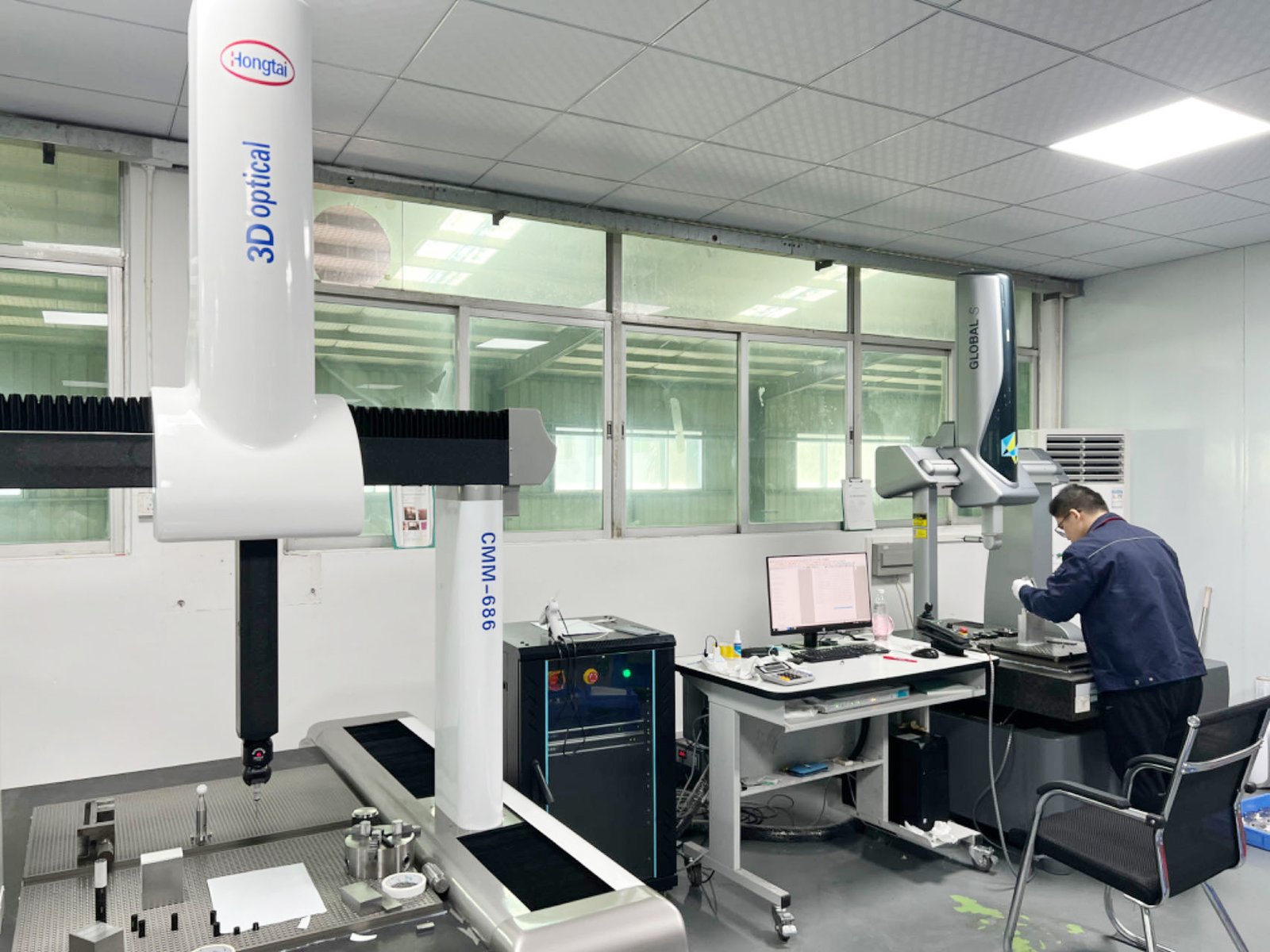
Parts from an online machining order should arrive with the same evidence as parts from any serious shop: a dimensional report on the characteristics that matter, tied to the model and the annotations it carried. The report should name what was measured, the value found, and the instrument used, and it should be readable against the model rather than against an invented standard. A CMM report that shows the bore, the pocket width, and the hole pattern with measured values is a report that lets the buyer verify the order without re-measuring everything.
Two questions deserve an answer from any online supplier before the first order, because they predict the quality of every later report. First, what measurement equipment does the floor actually use — the answer distinguishes a shop with a CMM and a profilometer from one quoting inspection it does not own. Second, what does the report include by default, and what costs extra — the answer tells you whether inspection is a habit or a line item. Buyers who ask these two questions once learn more about an online supplier than a hundred product reviews could teach them.
How do you build repeatable quality with the same supplier across orders?
Repeat orders to the same online supplier should get easier and better, because each order teaches the supplier your part family and your annotation style. Make the learning durable by keeping a specification template for your recurring parts — the annotations, the finish notes, the key characteristics, and the report expectations — so every new order starts from the accumulated knowledge rather than from a blank model. A supplier who sees the same deliberate specification across orders learns to quote it accurately and machine it without surprises.
Keep the relationship honest by reviewing each delivered batch against the specification and feeding the findings back. A batch that arrived clean confirms the specification works; a batch that revealed a missed annotation shows where the template needs another note. Over a few orders the template becomes the standing record of what your parts need — the tolerance bands, the finishes, the inspection level — and that record is worth more than the platform's catalogue, because it is yours.
And when the template says a part is ready for production volume, step the relationship up to the controls that volume deserves — sampling across the run, capability evidence on the key characteristics, and a standing report format — so the online convenience scales into a controlled supply line rather than a long series of single experiments.
Frequently Asked Questions
Are online machining platforms accurate enough for tight tolerances?
The machines are the same machines used by any precision shop; the risk is in the specification, not the hardware. A model without annotations gets quoted and machined to defaults, so the buyer must annotate the features that matter. Mark the functional features and the platform will hold them like any shop.
What happens if I do not annotate any tolerances on my model?
The platform will apply its default tolerance, which suits clearance features but may be far looser than a locating bore or precision pocket needs. The part will be machined to the default, measured against it, and will pass inspection while still failing your function.
How should I specify surface finish in an online order?
Through the platform's finish options where they exist, or through a note on the model stating what the surface is for and the Ra value required. A note such as "sealing face, fine finish" tells the process planner the surface is functional rather than cosmetic.
What is the realistic tolerance for milled features ordered online?
On controlled features, milling and turning hold ±0.003 mm, with Ppk ≥ 1.67 initial on characteristics the order flags as key. Features that need tighter go to precision grinding at ±0.002 mm, and the order must state that explicitly because no quoting engine adds grinding on its own.
How do I verify parts that arrive from an online order?
Ask for the dimensional report tied to the model annotations and read it against your specification. Ask what equipment the floor uses and what the report includes by default, because those two answers predict the quality of every later report.
When should I talk to a human instead of uploading a model?
When the part is critical, the features are tight, or the assumptions matter. The reliable route for a genuinely important part is to send the model and ask an engineer whether the annotations are sufficient, because an answer from a person who machines is worth more than an algorithm's guess.
Ordering a precision part online and want an engineer to check your model annotations before the quote runs?
Send the model to [email protected] or call +86 13126536955 and receive the tolerance and finish read before you commit. The services page, the quality page, and the FAQ page on this site describe the review process in detail.